
Resilient intentionality. Gardening. “Now faith is the assurance that what we hope for will come about, and the certainty that what we cannot see exists.” (Hebrews 11:1 ISV).
The gardens at our Church were begun as formal, referencing the Mediterranean gardens near the Italian church that inspired the design of our Sanctuary building. Landscaping to provide refuge and comfort. Pecan trees grew to provide shade and biennial harvests for all. Tomatoes were growing somewhere more than a decade ago, others remember different patterns of gardening including a courtyard Cross. Plants still grow that Curly Taylor planted, and native plants introduced by Lori Broughton still bloom.
We have memorial trees and memory plants from home gardens of members present, moved and lifted. Beloved Maxine helped with the initial seeding of the multicolored native firewheels (Gallardia pulchella). Seeding the first curbside terrace on the hillside, these sprouted, grew, bloomed and have now spread into other areas including the medians of 12th Street.
Bright blooms thru Springtime – red, yellow, and orange – scattered about. I will remember Maxine planting seeds, remember her greeting every visitor with affirming openness.
My intention began desiring to continue garden traditions and enhance the production of food. To grow nourishment – within reach; to invite a sense of sanctuary beyond the walls of our Church. Pastor Layne describes this as “softening the edges”. “Be joyful in hope, patient in affliction, faithful in prayer.” (Romans 12:12 KJV)
Our gardens are designed to accomplish many a purpose. I appreciate our volunteers, thank you all y’all. Softening the edges with flowers, herbs and foods for humans and wildlife, erosion control, soil building, drought resistance, plant resilience, refuge and comfort available to all as outreach.
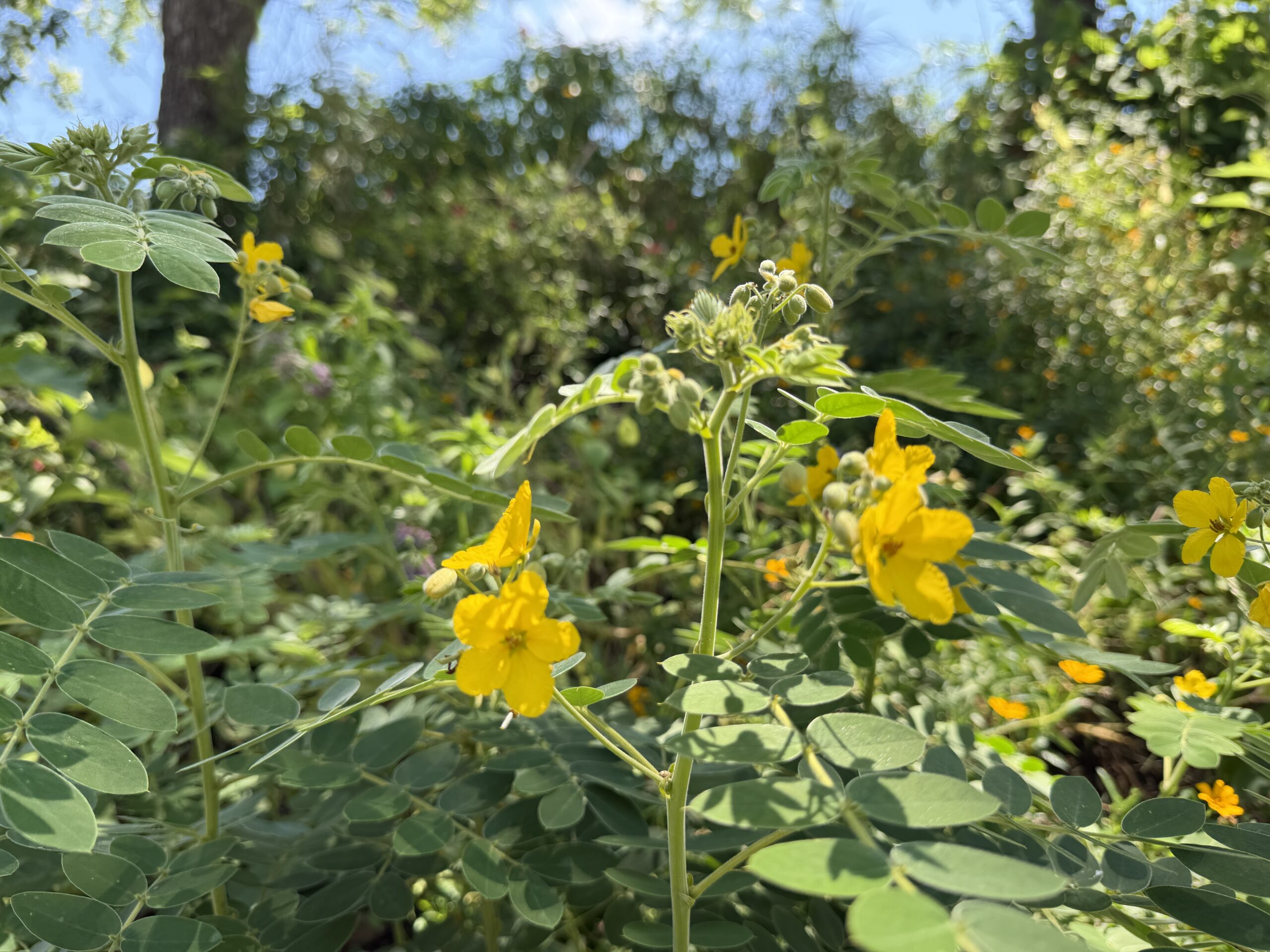
It’s easier to say, our gardens intentionally grow weeds. The sunflowers and moonflowers are weeds in a farmer’s field. Mint, mustard and chives spread beyond their beds; sea oats, lantana and okra appear each year in new areas. Wild petunias, orange zexmenia, yellow senna and bee balm multiply between the peppers and tomato’s along sidewalk and curb. The lamb’s ear like mullein – respiratory supporting for many – grows and thrives in sidewalk cracks.
“I will instruct thee and teach thee in the way which thou shalt go; I will guide thee with Mine eye. (Psalm 31:8 KJ21)
The resilience of our gardens has been tested by absence and reduction of active gardening this past spring. A time to watch, learn and review. I watched tree trimming crews dramatically prune our pecans. They were rightly focused only to remove and prevent contact between branches and utility lines. Their trimmings falling on and crushing some plants below, levels of terracing were breeched by the crews climbing the hillside to drag what they could into the brush chipper in the street. (It was going to be a bumper crop of pecans.)
Our gardens held, plants survive to bloom again, the terraces continue to build soil sufficient for easy repair. Most of the veggies in that curbside row were trampled and lost, but that row produced a surprising bounty of kale, cabbage, beets, beans, herbs and swish chard over the winter. It is a good time to rest the soil. Birds, butterflies and wildlife are eating now.
In watching, I’ve learned new ways to partner with Creation, new ways to grow sunflowers, new ways for the gardens to sustain a presence of intentional refuge and sanctuary.
“We are assured and know that [God being a partner in their labor] all things work together and are [fitting into a plan] for good to and for those who love God and are called according to [His] design and purpose.” Romans 8:28 (AMPC)
Peace, Phil